Tuesday, February 28, 2006

SUGANDOI KAAMATAN


BENGKEL SUGANDOI & ORKESTRA KOISAAN
Pada 19hb Mac 2006 di Hongkod Koisaan, Penampang

KOTA KINABALU: Bengkel Sugandoi dan Pengenalan Orkestra Koisaan 19 Mac di Hongkod Koisaan Penampang akan meninjau perkembangan lagu-lagu tempatan di samping memperkenalkan skema baru corak pengadilan Pertandingan Sugandoi Kaamatan.
Pengerusi Jawatankuasa Sugandoi Kaamatan, Harry Ignatius Beatty berkata perasmian Bengkel Sugandoi yang dijadual dirasmikan Huguan Siou Datuk Seri Panglima Joseph Pairin Kitingan itu turut memperkenalkan penampilan pertama Orkestra Koisaan yang dianggotai kira-kira 80 pemuzik.
“Melalui Bengkel Sugandoi kita berharap dapat menghasilkan bahan-bahan tulisan mengenai perkembangan lagu-lagu tempatan khususnya Kadazandusun Murut di samping merumuskan corak pengadilan Sugandoi Kaamatan di seluruh Negeri Sabah,” kata Harry.
Harry yang juga Ahli Jawatankuasa Pusat Persatuan Kebudayaan Kadazandusun (KDCA) menjemput semua peminat dan penggiat lagu-lagu tempatan agar mengambil peluang menyertai bengkel sehari itu kerana ianya merupakan asas kepada pengembangan indusrti muzik tempatan pada masa akan datang.
Menurut Harry, sebanyak tiga kertas kerja dibentangkan pada bengkel itu yang meliputi Perkembangan Lagu-lagu Kadazandusun Murut, Perlindungan Hakcipta dan Pengadilan Sugandoi.
“Para pembentang kertas kerja terdiri dari kalangan Pensyarah Seni Muzik dari Institusi Pengajian Tinggi Awam (IPTA) di Kota Kinabalu. Melalui ceramah pengadilan sugandoi kita perlu melihat kemungkinan bahawa pada masa akan datang, hanya mereka yang memiliki tauliah disyorkan menjadi pengadil sugandoi,” kata Harry.
Sementara itu, Orkestra Koisaan dianggotai 80 pemuzik lulusan Ijazah Sarjana Muda Seni Muzik akan membuat penampilan pertama yang mengandungi rhythm, high string, low string, brass, saxes, woodwind, tradisional dan vokalis dengan persembahan iringan vokal serta instrumental termasuk lagu-lagu Kosorou Ko Po Nangku Doho, Siou, Medley Sumazau John Gaisah, Lambaian Kinabalu, Jinulim Batu Lapan dan Nokopisoomo om Nokopitongkizad.
Keterangan lanjut penyertaan diminta menghubungi Hongkod Koisaan 088 713696 (Maureen/ Rita) untuk memasukkan nama dalam senari. Yuran penyertaan RM20 setiap peserta.
Aturcara Bengkel Sugandoi & Pengenalan Orkestra Koisaan
Tarikh: 19 Mac 2006 (Ahad) Tempat: Hongkod Koisaan, Penampang
10.00 pagi - Pendaftaran
11.00 pagi - Ketibaan Huguan Siou Datuk Seri Panglima Joseph Pairin Kitingan, Presiden KDCA/ Timbalan Ketua Menteri Sabah (disambut dengan persembahan muzik Orkestra Koisaan)
11.05 pagi - Ucapan alu-aluan Pengerusi Sugandoi Kaamatan, Gund. Harry I. Beatty
11.15 pagi - Ucapan Perasmian oleh Huguan Siou (Persembahan Orkesta Koisaan)
Pengenalan singkat Orkestra Koisaan oleh JuruacaraPengurus Orkestra Koisaan OKK William Majimbun menyampaikan profail orkestra kepada Pengerusi Sugandoi Gund. Harry Beatty untuk disampaikan kepada Huguan Siou. Profail akan dijadikan asas perbincangan KDCA selanjutnya.
12.00 tnghr - Hidangan Tengahari
12.40 tnghr - Ceramah Pertama: “Perkembangan Lagu-lagu Kadazandusun” Oleh: Andrew Poninting, Pensyarah Muzik UMS
1.30 petang - Buah Fikiran: “Perlindungan Hakcipta”
1.50 petang - Sesi bengkel
Pengerusi: Gund. Albert Mark Moguring Pensyarah Muzik Maktab Perguruan Keningau Pencatat: Zandi Janeta Anthony
2.30 petang - Hidangan Teh
2.45 petang - Ceramah Ketiga: “Pengadilan Sugandoi Kaamatan” Oleh: Gund. Rayner Ajumal, Pensyarah Muzik Maktab Perguruan Gaya, KK
3.45 petang - Sesi Bengkel Pengerusi: Zandi Juliana Andreas Pencatat: Zandi Christina John Luan
4.15 petang - Rumusan oleh Pengerusi Sugandoi Gund. Harry I. Beatty

Source: Henry Bating (013 858 0885)

Monday, February 27, 2006

SUNDA SHELF


SUNDA SHELF CIVILIZATION:
WERE THE KADAZANDUSUNS PART OF IT?
By
Allan Dumbong

Dear All Tobpinais Kadazandusun:
Attached herewith is a very intersting article, implying that we Kadazandusuns were once part of a great (and in fact the earliest) civilization. The Sunda Shelf or “Sundaland” Theory says that Borneo was once part of the connected continent before the Ice Age +-11,000 years BC. After Ice Age, the Sundaland melted and many people either died drowned or migrated to other places, most likely India and China. What happened to the “mololohing” kadazandusuns? May be, two(2) possibilities:
  1. Went to China and then descended to Taiwan, Philippines and Borneo (like the one promoted by the Austronesian Theory) ; or
  2. We went up to Borneo, climbed Mt Kinabalu, stayed there and, now we are STILL here.

Ok, This is my opinion. I may be wrong, but I could be right to a certain extent. But, as what people say “Curiosity kills a cat”. So, I encourage you to read the following article. If you need more, do a yahoo search for some keywords like “Sunda Shelf”, “Sunda Land” , “Ice Age”, “Atlantis”, “Eden of Southeast Asia”, “Austronesian”, and you'll be rewarded with a "very inquisitive mind", which you may cherish in the future. Sounds philosophical ah?, Yes indeed, I'm trying too.


Contributed By:Allan G Dumbong, B.A Hons (Anthropology/Sociology/Political Sc.),

MBA
allandumbong@yahoo.com.my

The Cradle of Human Civilization
The cradle of human civilization may well have been the prehistoric lowlands of the Southeast Asian peninsula, rather than the Middle East. But since those lowlands catastrophically ‘sank’ beneath the seas thousands of years ago (actually drowned by rising sea levels), humanity has remained unaware of their possible significance up through the early XXI century.
Unaware except, that is, for a so-called myth perpetuated by Plato, before 347 BC. Plato spoke of an advanced civilization named Atlantis, which sank below the seas perhaps around 9,000 BC. It may well be he wasn’t so far off after all.

In the early XXI century the pieces of the puzzle are gradually coming together. Prehistoric human migration patterns made for population densities capable of building civilizations in southeast Asia possibly many thousands of years before such occurred in the Mid-East. The people of the region were very similar to modern humans in their physical and intellectual potentials — and displayed agricultural practices which wouldn’t be seen elsewhere in the world until many millennia later. We also now know that it is indeed possible for catastrophes to wipe out entire civilizations, perhaps leaving little to no evidence behind of their passing.Moreover, mitochondrial DNA analysis indicates most Amerinds (majority of native north Americans) arrived in one wave around 38,000 BC - 18,000 BC. The genetic diversity in native Americans strongly implies at minimum 30,000 years of development on the continents (under some reasonably plausible scenarios). The 140 language families of native Americans suggests 40,000+ years of development.

Scientists estimate it should have required 7000 years of progressive migrations for people to reach and settle the vicinity of Monte Verde Chile, if they first entered the Americas by way of the Bering land bridge some 9000 miles away (if Monte Verde was settled by 31,000 BC, which it appears it was, then allowing 7000 years to reach it from Beringia results in a date of 38,000 BC for crossing the land bridge).
We have only recently begun to realize that much of human prehistory must now lie buried in the ocean floor due to the rising seas of 15,000 BC - 3,000 BC; so only extensive submarine efforts may enlighten us as to our true past prior to around 4000 BC. Another obstacle has been our inadequate technology for such submarine explorations. This too has only recently begun to be rectified.
More history is waiting to be discovered under the sea than in all the world’s museums combined», undersea explorer Robert Ballard said in 2000. 71% of the Earth’s surface is covered by ocean; roughly 5% of it has been explored. The planet’s most spectacular mountain ranges are undersea, and as yet unconquered. The sea bottom represents a vast unexplored continent.
In 1926 James Churchward published the book The Lost Continent of Mu. It made the bold claim that an advanced prehistoric human civilization had existed in southeast Asia, but succumbed to earthquakes and a fiery inundation around 23,000 BC. Both before and after the disaster, the people of Mu had supposedly traveled widely about the Earth, mingling with other peoples and colonizing other lands.Hard evidence of Churchward’s claimed sources has never been found. Sundaland is the proper label applied to the largest single section of Asian real estate submerged by rising sea levels after the last Ice Age (the lowlands of the greater southeast Asian peninsula). There are signs that all this land submerged by rising ocean levels was previously comparatively densely populated by human beings.The Asian legend of Lemuria is somewhat similar to the western tales of Atlantis, involving a great land-mass which sunk beneath the seas long ago.
Great flood myths and folklore are common among many peoples, including those of Asia and the Pacific region. These flood-related tales may well relate prehistoric people’s perceptions of rising sea levels and glacial floods triggered by the end of the last Ice Age. The now undersea Sunda shelf of the southeast Asian peninsula, or Sundaland, seems a ripe place for research into prehistoric human settlements and perhaps even civilizations, forced to migrate to other lands or drown.
The Tamils have a tradition that their Sangam poetic academy has a history of 10,000 years, and that its center (along with the entire Tamil capital) has been forced to move three times due to rises in ocean levels. They also believe that their country in the past stretched deep into the south, including Sri Lanka and the Maldives, as the lost continent called Kumarikhandam.
In a recent book, Eden in the East — the Drowned Continent of Southest Asia (1998), Stephen Oppenheimer has focused on one such part of the continental shelf: the region between Malaysia, Sumatra, Java, Borneo, Thailand, Vietnam, China and Taiwan, which was largely inhabitable during the Ice Age. Thinking that this was then the most advanced centre of civilization, he calls it Eden, the Biblical name of Paradise (from Sumeria, edin, “alluvial plain”), because West-Asian sources including the Bible do locate the origin of mankind — or at least of civilization — in the East. In some cases, as in Sumerian references, this “East” is clearly the Harappan or pre-Harappan culture, but even more easterly countries seem to be involved.Homo sapiens were clearly in the region of Sundaland as far back as 43,000 BC to 28,000 BC; and so almost certainly traveled and lived on the vast dry lands existing there due to Ice Age lowered sea levels prior to 18,000 BC to 16,000 BC.
Between 12,000 BC and 5,000 BC it appears that massive inland flooding due to catastrophic glacier melt was taking place in several regions of the world, making for subsequent sea level rises which could be relatively abrupt for many worldwide — including folks living on the remaining lowland portions of the original swollen southeast Asian peninsula of the time.
The majority of high profile sites of Southeast Asia from early Neolithic times are caves, which suggests that more advanced settlements of the period had been drowned by rising sea waters created by the aftermath of the Ice Age.
Southeast Asia is much larger circa 23,000 BC than it will be in 2000 AD, with a single continuous land mass encompassing Java, Indonesia, Borneo, and India, Vietnam, China, and Korea, all boasting vastly swollen coastlines compared to 2000 AD.
The most inviting spots climate-wise of this time seem to include Middle Africa, the swollen mass of Southeast Asia, and Australia, all straddling the equator of a planet deep in the throes of an Ice Age. All these places offer large amounts of grass and dry woodland and forests, with perhaps around 30-50% rain forest and 20% or so desert or tundra.
The present window of abundant and lush lowlands on the southeast Asian peninsula will come to a close by around 13,875 BC as sea levels begin rising and taking back what once was sea bed. Thus, these lands will enjoy only something like 11,000 years of development as dry land before they are submerged again.It is also true that these lowlands of a greater southeast Asian peninsula are very vulnerable to tsunamis (tidal waves) stemming from such things as earthquakes about the Pacific Rim, asteroid or comet impacts in the Pacific, Hawaiian lands-lips, and various volcanic eruptions in the Pacific region. Fortunately, Hawaiian lands-lips seem to take place only once every 100,000 years, and cosmic impacts of consequence here perhaps only once every 600,000 years, on average. So the 11,000 years window for civilization on the southeast Asian peninsula appears likely to have remained unbroken by those sources of havoc. Volcanic eruptions however are more frequent and troublesome for this region — and the glacial weight which subdues such eruptions elsewhere is absent in the vicinity of the peninsula of this time. And devastating tropical storms and hurricanes would be more frequent still.
All this leaves us with the southern coasts of India, and the south and east coasts of Asia. With the southeastern peninsula smack in the middle of the Indian coasts and the combined regions of the dry Yellow Sea and East China Sea.
At this time in human prehistory, population densities and easy migration paths favor these Asian regions — even to the point that there could easily have been three separate centers of civilization distributed among them. Specifically, the centers of gravity for three such states ultimately fated to drown undersea could have been in the vicinities of coastal India, the now (23,000 BC) dry sea bottoms of the combined Yellow and East China Seas (bordered to the north by Korea, and separated/sheltered from the Pacific by a small shallow sea and a mountainous archipelago which someday will form the southern extremes of the Japanese isles), and the lowlands of the southeast Asian peninsula — with the peninsula lowlands perhaps being the most favored of all, due to location, climate, and other matters. Note however that the extreme eastern regions of the Yellow and East China Sea bottoms would have offered a fabulous location for sea commerce ports, as well as better protection from Pacific tsunamis than most anywhere else in the region.
From 148,000 BC to 48,000 BC world population hovered around 11,000 to 40,000. By 8,000 BC world population may have been something under 10 million.Assuming the fraction of these living in Antarctica and the Americas at the time is negligible, this leaves over six million to be spread over Eurasia and Africa.
In population density maps of the world for One AD (the earliest available from the site cited below), by far the greatest density appears to be along the eastern coast of China. The second greatest density is along the southern coasts of Asia, such as India. Lesser spots of significant human population are few and far between, with a tiny amount on the west coast of Africa.
Thus, it appears the bulk of this six million plus people in 23,000 BC likely live either on the east coast of China, or spread across the south coast of Asia, according to these maps. Note that the inviting tropical southeast Asian peninsula exists smack in the middle of these migration destinations, yet by One AD appears curiously under-populated considering its locale and climate. Could it be that the rising seas which inundated vast tracts of the peninsula between 15,000 BC and 3,000 BC — plus the increasing reach and intensity of storms in the area which accompanies such sea level rises — frightened off a substantial population after thousands of years of steadily encroaching submergence and destruction? Eventually, succeeding generations would come to expect that the invading sea would never stop coming, and perhaps head for the mainland where safer and more permanent settlements might be established. As if these incentives for exodus were not enough, the region is also afflicted with some of the most active volcanoes on Earth, as well as frequent earthquakes. Add in a possibly memorable, even terrifying war or two on the peninsula in its heyday, and you couldn’t come up with a better excuse for multiple generations to flee the region where feasible for them to do so.
People in general have possessed spoken language pretty much globally for at least 75,000 years by now, and perhaps for many hundreds of thousands of years. They have possessed some access to fire for nearly one and a half million years (though the secret of fire-starting may still elude them, forcing them to maintain perpetual fires in community hubs or else seek a flame from neighbors or others; such perpetual fires often burn for years or decades between extinguishing). One element helping make fire more practical is that lamps have been available for almost 50,000 years now (perhaps longer).The humanity of this period may have possessed brains roughly the same size as XX century man’s for close to 800,000 years by this point.
It is possible that the people of 22,425 BC possess quite sophisticated clothing, body art, and personal accessories, as well as jewelry, fishing and hunting nets, ropes, cords, and string by this time — and perhaps have for at least a couple thousand years already. Musical instruments such as flutes have existed for at least 25,000 years by now. Man-made housing has existed for more than 375,000 years. Food and drink containers have been in use for at least around 80,000 years, perhaps almost half a million. True pottery has been in use for at least around 10,000 years already in Asia.
The prehistory of man may be, after all, full of fascinating misteries waiting to be discovered.

Friday, February 24, 2006

GREETINGS

EVERYDAY GREETINGS IN TAGALOG, ENGLISH & KADAZANDUSUN
By Allan Dumbong

I like to share here how do we greet in three languages, tagalong, English and Kadazandusun. For example

Magandang umaga po. (formal/polite) - Good morning kopisanangan kosuwabon
Magandang umaga. (informal) - Good morning
Magandang tanghali po. (formal/polite) - Good noon kopisanagan tangaadau

Magandang tanghali. (informal) - Good noon
Magandang hapon po. (formal/polite) - Good afternoon kopisanangan dongsosodopon

Magandang hapon. (informal) - Good afternoon
Magandang gabi po. (formal/polite) - Good evening kopisanangan doungosodop

Magandang gabi. (informal) - Good evening
Kumusta po kayo? (formal/polite) - How are you? Okuro-kuro koh no?

Kumusta ka? (informal) - How are you?
Mabuti po naman. (formal/polite) - I'm fine Osonong-Ononong ih boh.

Mabuti naman. (informal) - I'm fine
Tuloy po kayo. (formal/polite) - Please, come in Bah, suang noh.

Tuloy. (informal) - Please, come in
Salamat po. (formal/polite) - Thank you Pounsikou

Salamat. (informal) - Thank you
Maraming salamat po. (formal/polite) - Thank you very much Kotoludan

Maraming salamat. (informal) - Thank you very much
Wala pong anuman. (formal/polite) - You are welcome Miagal nopo

Walang anuman. (informal) - You are welcome
Opo/ oho. (formal/polite) – Yes Om

Oo (informal) - Yes
Hindi po/ho (formal/polite) – No Au

Hindi (informal) - No
Hindi ko po/ho alam. (formal/polite) - I don't know Au oku kiolo

Hindi ko alam. (informal) - I don't know
Anong oras na po? (formal/polite) - What time is it? Pukul nunu no ti?

Anong oras na? (informal) - What time is it?
Saan po kayo papunta? (formal/polite) - Where are you going? Nombo ngoyon nu?

Saan ka papunta? (informal) - Where are you going?
Saan po kayo galing? (formal/polite) - Where did you come from? Mantad ko nombo?

Saan ka galing? (informal) - Where did you come from?

Ano po ang pangalan nila? (formal/polite) - What is your name? Isai Ngaran Nu?

Anong pangalan mo? (informal) - What is your name?
Ako po si ________ (formal/polite) - I am ______ (name). Ngaran ku nopo nga………..

Ako si _________ (informal) - I am ______ (name).
Ilang taon na po kayo? (formal/polite) - How old are you? Piro noh umur nu?

Ilang taon ka na? (informal) - How old are you?
Ako po ay _______ gulang na. (formal/polite) - I am _______ years old. Umur ku nopo nga……toun

Ako ay _______ gulang na. (informal) - I am _______ years old.
Saan po kayo nakatira? (formal/polite) - Where do you live? Nombo ko poingiyon?

Saan ka nakatira? (informal) - Where do you live?
Taga saan po sila? (formal/polite) - Where are you from? Mantad ko nombo?

Have you eaten yet? Nakaakan kono?Kumain ka na ba? (informal) - Have you eaten yet?

KADAZANDUSUN VILLAGES

KADAZANDUSUN VILLAGES:
THE MEANING BEHIND "KI"
By
Allan Dumbong

If you going to the countryside of Sabah, especillay in the predominantly Kadazandusun villages, you'wll see that many of the villages are names starting with the letters "Ki". For example, "kionggu", "kituau" etc. Surely, there are meaning of all these names.
Based on my knolwedge about the Kadazandusun language, I can safely say that the names of the villages have originated from certain resources available in the said villages.
  • KIRONGGU - A village which has plenty of "ronggu" trees.
  • KIONGGU - A village which has plenty of "ronggu" trees. "Onggu" is in Kadazan tangara dialect.
  • KITUAU - A village whic has plenty of "tuhau" plants.
  • KITOWU - A village which has plenty of "towu"
  • KIULU - A village which has plenty of "wulu", one type of bamboo.
  • KIPANGI - A Kg which has plenty of "pangi", a type of tree which bear fruits that can be used to preserve meat, fish etc.
  • KILUGUS - A village which has plenty of "lugus" or pinang in Malay.
  • KIPUNGIT - A village which used to have plenty of "pungits", or bats.
  • KIROKOT - A village which used to have plenty of "rokots", a type of fish found in the streams in the rural areas.
  • KIMANIS - Ogumu "kayu manis" toi ko "kenangan manis".
  • KITOBU - A village which used to have plenty of sugar cane.
  • KIPUNTI - A village which used to have plenty of banana trees.
  • KIAMBALANG -A village which used to have many "tamalangs" or bamboo.
I believed many people, particularly the young generations do not understand the origin of the words, and the background history of their villages. I hope this would help, not only in enlightening the people about the past history of their respective villages but also to help in conserving the enviornment. Love your plant or the resources available in your respective kampungs. Based on the names, you could see the opportunity that your particular kampung could be a place to re-plant the plants or trees or to rear certain types of fish or animals.
I still remember, the State Government of sabah used to encourage people to have "one village one industry". I believe the word "Ki" would help us to identify the core industry or the main resource in the kampung.

Sunday, February 19, 2006

KENINGAU DISTRICT


A GLIMPSE OF KENINGAU DISTRICT
By
Allan Dumbong
INTRODUCTION
I am pleased to share about the background of the District of keningau, where I was born in 1964. Keningau, is indeed, a very interesting and popular district, not only because of its long history of its modern administration, or the application of its native laws, or its beautiful landscaping and scenary but also because of its cultural richness.

Keningau is the oldest and largest district in the interior part of Sabah. According to stories, last time this District has many “Kayu Manis” trees which is also called “Kayu Keningau”. The Skin of the trees can be made into spices and becomes favorites to traders from outside, especially from the West. The Englishmen collected he skin of ”Kayu Keningau” trees and sold internationally by The North Borneo English Company (Syarikat Inggeris Borneo Utara) in spice trading. The traders started to learn about the “Keningau” Trees. They are moved to gain more of the “Kayu Keningau” therefore making the name “Keningau” becomes famous in the interior. Because the “Kayu Manis” Trees are called “Keningau” Trees, therefore the village people start to call the village Keningau. And to eases the introduction of the Keningau District, The Keningau District name is put in the North Borneo Map (now are called Sabah), therefore The Keningau District has established its name. That’s how The Keningau District got its name, which is from a “Kayu Manis” tree in Malay and the “Keningau” tree in the local dialect.

KENINGAU DISTRICT LOCATION
The Keningau District has an area of about 353,282 hectare or 872,960 acres (1364 square miles) situated in a land surrounded by the Crocker Range on the West and the Mt Trus Madi on the East and South.

POPULATION
Based on the Census by the Statistics Department of Malaysia (2000), 90 % of the population in Keningau are Kadazandusun and Murut, 8 % Chinese and other locals. This do not include the illegal immigrants.

TOTAL OF LOCALS
Kadazandusun - 59,607 peoples
Murut - 23,823 peoples
Cina - 9,082 peoples
Bajau - 3,903 peoples
RELIGIOUS BELIEFS
Generally, the people of Keningau profess certain religion. It is estimated that about 60% of the people of Keningau are Christians, 30% are Muslims, and the remaining are other beliefs like Buddhism etc. Churches, Mosques, and Chinese temple are found in many places in Keningau. Despite having different creed, the people could mingle and live with each other harmoniusly.
COMMUNICATION
The Keningau township are connected by road through the Kimanis/Papar and Tambunan road from Kota Kinabalu City about 138 Kilometers. 67 Kilometers form Nabawan, 35 Kilometers from Sook and 48 Kilometers from Tenom. Apart from that, an airport for small aircraft was also built, for flights three times a week (Monday, Wednesday and Friday) from Kota Kinabalu, but unfortunately the service is cancelled currently due to the up-gradation of the airport.
About 45% of keningau has been covered with the telecommunication networks, either through cable or wireless technology. About the same percentage are also benefiting from other basic facilities like electricity and chlorinated-water supply.

ADMINISTRATION AND DEVELOPMENT OF THE KENINGAU DISTRICT
The Keningau District is administered by few State Department and the Federal along with the Locals, where the District Office act as the central administration department. The Keningau town is adminsitred by the Keningau District Council.

Friday, February 17, 2006

SABAH-CHINA EARLY TRADE RELATIONS

SABAH-CHINA EARLY TRADE RELATIONS
By
Allan Dumbong

Based on my preliminary anthropological research, there are evidences that Sabah/North Borneo/or other names before have established trade relations with China. This is a good news to the people of Sabah, which has a significant number of Chinese, whose forefathers migrated from China to Sabah few hundred years ago. This is also a good news to the indigenous of Sabah, like the Kadazan Dusun, who may have had contacts with the Chinese traders long time ago. Our history is believed to be long, but our recording and documentation of historical events are very poor and, indeed very short. It is very difficult even to trace our history of more than 1,000 years ago.

Anyway, today I visited the Exhibition and Auction of Antiques organized by Nanhai Marine Acheology Sdn Bhd at Waterfront Kota Kinabalu (18-19/2/2006). There I met one Mr Johan Milton who was manning the exhibition and he enlightened me that indeed the Ship Wreckage at Tanjung simpang is the earliest record of China trade in Sabah. This is inetersting.

Then I relate this wreckage story to the Austronesian Theory and the Sunda Shelf (Sunda Land) Theory which make the cultural anthropology a lively topic of discussion here in Sabah. At this stage, I am only deeply interested to know more about this whole story. But then, in view of time and financial constraint, I don't think I'll be able to dig more in a short span of time.

But then again, the point is, Sabah and China have established trade relations long time ago. Up until now, Sabah and China still maintaining a high volume of trade, albeit the trade balance is more bias to China.
I'll write more on this subject in future. But for the time being, suffice for me to introduce you the website: http://www.mingwrecks.com/, which carries the following article about ship wreckage, Sabah-China Trade Relations in the early days. Anybody interested to join me in exploring more research on the earlier trade and probably diplomatic relations between Sabah-China, please do not hesitate to contact me. I can even connect you to the relevant people in the Sabah State Museum and the Nanhai Marine Acheology Sdn Bhd. I also welcome if there is any university or organization that would like to conduct research on this, and to work with us or to sponsor our research work in this area.

Sung pottery from The Tanjung Simpang Shipwreck (AD. 960-1127)
Source: www.mingwrecks.com, 18/2/2006
A 1000 year-old wreck site providing Archeology and Art history with new information.The Tanjung Simpang shipwreck site, the oldest in Malaysian waters, was unusual in many ways. It was the only site the company discovered in shallow water and close to shore. The site was heavily looted by local fishermen. Despite this looting, a number of Sung dynasty ceramic wares and few hundred kilos of pottery shards were recovered together with bronze gongs. Some of these gongs were signed with Chinese characters, painted on the reverse.It has been known for a long time that the ancient Chinese potters made markings in the base of his pots to identify each individuals wares after its firing. These markings are referred to as "potters marks". Few of the Tg. Simpang ceramic wares had "potters marks" painted in the base of the pots. These characters are however masterly executed, and question its signing by a lesser educated potter.Luckily, the bronze gongs remaining on the site showed identical painted characters as those seen on the pottery. Such identical markings should start a new debate about whom and when the artefacts were signed and for what purpose. The main point of contention seems to be if the pots were 'signed' before or after it firing and if it should continually be refrred to as "poters marks".
BRIEF DISCOVERY REPORT
One argument presented here, with the evidences from the Tanjung Simpang shipwreck, is that these markings were not "potters marks" but markings made by the Captain or an onboard merchants to identify their individual objects when reaching their destination.
INTRODUCTION:The Department of Sabah Museum provided Nanhai Marine Archaeology Sdn. Bhd. with a search/inspection permit in March 2003. The main intent with applying for such permit was a desire to extend the chronology of shipwrecks already discovered, investigated or excavated by the company in West Malaysia. Another objective was to locate a Sung dynasty site that had provided antique shops in Sabah with illegally salvaged pottery.If a shipwreck of archaeological importance was discovered, then it was also desirable to use such a site to continue training Malaysian nationals who had received basic archaeology training during the company's excavation and mapping of the Desaru (+/- 1830) shipwreck.The terms of the permit allowed the company to investigate any historical site within a specified area and thereafter decide whether or not to commence full-scale archaeological excavation. This condition was inserted as the company would have a preference for excavating shipwrecks that were intact and of such nature that it would complement the knowledge earned from other sites already excavated. If this option were declined, then the site would be transferred to the Department of Sabah Museum for excavation and/or training.
THE WRECKSITE:
Directed to an area off Tanjung Simpang-mangayau, the northwestern point of Sabah, by a local fisherman (who prefers to remain anonymous) the site was discovered on the 15th of April 2003. It was located 400 meters from the shore and in twelve meters of water.The surface of the site is sandy but close to the fringing reef edge. The only indication of a shipwreck was stacks of bronze gongs that could be discerned above the flat seabed. This sandy layer varied between two and three feet in depth and is likely to have accumulated after the ship sunk.This location is directly exposed to the northeast monsoon winds that generate large waves, which increases in height as they meet shallower water. After sinking, the ship appears to have landed on coral rocks. Pounding on these rocks by every wave, the ship is likely to have broken up almost immediately. This theory seems supported by the number of artefacts found scattered between the rocks. Assuming that the ship sailed directly from China, it may have been damaged on the reefs extending east and west from Pulao Kalampunian and then sunk before the shore at Tanjung Simpangmangayau.
THE LOOTING:
The looting of the site was extensive and large volumes of ceramics had been removed. It is likely that original stacks of ceramics were loaded level with the existent height of the bronze gongs. Now, only broken pottery and shards could be seen in the bottom of the crates, blown between the stacks of gongs.When the initial inspection ended on the 16th of April due to the onset of spring tide, two intact storage jars was left partly buried as a marker for continued inspection after the spring tide. Returning on the 21st of April, these two jars were lying next to their original location, smashed to pieces.The same evening a marker buoy was left on the site for ease of continued work. Returning early the following morning, a smaller fishing boat (No.3932 with Mr. Abdul Rahman on board) were found anchored at the site and its crew preparing to dive. Leaving the site in the evening of the 22nd of April after back-filling the test holes, two similar fishing boats (with hose-diving gear onboard) were seen traveling towards the site.
THE SHIP:During the inspection, very little ships timber was noted. The few pieces found were broken in short length and dislocated. No direction of the ship could be confirmed from the direction of these pieces. Attempts to locate scars from perpendicular transverse bulkheads in one specific piece of hull timber were also not conclusive. A sample of wood was collected for identification purposes. This piece is most likely from a tempered climate timber, probably pine, fir or cedar, which suggest that the ship was built in China.
CERAMIC ARTEFACTS:
The disturbed location of artefacts, likely dislocated by looters and the ships damage by the reef, made it meaningless to record each artefacts precise location. Instead it was decided urgent and prudent to rescue as much as possible, preventing remaining objects from looting. It was obvious that such ceramic assemblage was valuable from an art historical view as it represented trade wares available at one precise time in history.For that reason, a number of test holes were made throughout the site. Without any orientation, only a few of these artefacts could be assigned a preliminary location reference. From this it appears that most ceramic artefacts were located on the site's western perimeter.Each type of ceramic was photographed and provided with a general description, such that every diver could register each piece recovered in a uniform manner. The attached General Description of Artefacts lists all these different types of ceramic and non-ceramic artefacts. A total of three hundred three ceramic artefacts were registered in this mannerAll 'ceramic artefacts' are those that maintain more than fifty percent of its original shape; all other ceramics were considered 'shards'. Approximately two hundred and fifty kilo of shards were collected as reference objects. Due to its disturbed location, shards, did not receive individual registration numbers.
NON-CERAMIC ARTEFACTS:
The bronze gongs appear to be some of the earliest types imported into Southeast Asia. The diameter vary between 39 and 43 centimeters. The surface is slightly curved and without any center protrusion, commonly seen on later gongs. The sides are bent in almost ninety degrees to the surface allowing stacking. The weight of these gongs varied between three and four kilos. A total of sixty-one bronze gongs were recovered.Other non-ceramics included round and oval shaped copper ingots that appeared to have been casted in simple sand moulds. Three sizes were found: 10-13 cm, 14-17 cm and 18-20 cm in diameter. Weights varied with size: 0.5 kg, 0.75 kg and 1 kilogram. Seventy-six copper discs were recovered.
DATING:
Based on the ceramic pieces alone it would appear that the ship was loaded with Chinese ceramics made during the Northern Sung dynasty, sometime between AD. 960 and 1127. Although some features and styles pieces appear earlier, other forms are often attributed to a later period. Before providing a tentative date for the site, more experts will be consulted. The combined result of such opinions will be published at a later date.

Tuesday, February 14, 2006

KAAMATAN 2006


KAAMATAN 2006: CALLING FOR MORE
KADAZANDUSUN YOUTHS INVOLVEMENT
Posted By:
Allan Dumbong
Kadazandusun Youth Development Movement (KDYDM), a group within the Kadazandusun Cultural Association (KDCA), is pleased to invite Kadazandusun youths to participate actively in helping to organize the forthcoming Kaamatan Festival 2006. The areas that the youth could play prominent roles include the followings:

(i) Research and documentation of all the activities, events during the month long kaamatan throughout Sabah, Labuan & Klang Valley. We need youths to help collect the information,including photos, video, brochures etc from all the districts. The aim is to have a good collection of materials of the Kaamatan 2006 to be kept in KDCA's Archive. Another objective is to develop a Kaamatan Operations Manual based on the Management of Kaamatan 2006 to be used and improved in the years to come.

(ii) To get involved in other activities like Fund Raising/Business for KDYDM, Sugandoi, Unduk Ngadau, International Relations, Traditional Sports etc during the Kaamatan 2006.

For these purposes, KDYDM cordially invites any interested Kadazandusun youths to attend the following meeting:

Date: 18/2/2006 (Saturday)
Time: 3.00pm
Venue: Hongkod Koisaan, Jln Penampang.

If you are keen to help develop our Kadazandusun community, please call or email me:

Allan G Dumbong
Central Committee Member/
Chairman
Kadazandusun Youth Development Movement, KDCA
Tel: 019-8310466
Email: adumbong@yahoo.com

Sunday, February 12, 2006

MY JOURNEY

MY JOURNEY
By
Allan Dumbong

PART I: BORN TO THE WORLD
Born on 8th May 1964 at Kg "4 4" (now called "Nuntunan") Apin-Apin, Keningau. 4 4 means Mile 44, from Tenom to Jesselton. My parents, Dumbong Dimbak (d) and Lungkiying Sombihil. My father originated from Kg Tinompok Liwan, Tambunan whereas my mother from Kg Garas, also in Tambunan.
My parents have migrated to Telipok to worked in British Rubber Estate for few years before moving to Kg Langkawit, Batu 5, Papar. Then, could not settled in Langkawit, they returned to Rubber Estate and lived in Kg Keliangau, Menggatal. Among their acquantances were the Mintows, Modulis, Sendeluns etc. Still could not settled in Menggatal, they left everything to move to Keningau. Finally, they settled down in Kg Apin-Apin. There I was born.
I was born special. First, I was concieved after my mother and father "prayed" to Kinorohingan during a moon eclipse. You see, before me there were 6 siblings. The eldest is my brother, Ongul, then followed by 5 girls, Gorodot, Gurisah, Lupinah, Yulin, Yulipah. Felt short of boy, my parents prayed hard. When I was born, the bidan kampung delivered me, not easy cos I was "sonsang", kind of legs first. My mother fought for her life, as well as mine. During that day, there was a neighbour passed away. To their beliefs, these two events whould not happen at the same time. Anyway, fated, that was the story. Many believed that with that kind of background I should possesses certain "power", "magic" or supernatural insticts. As a kid, I always get invited to cure people who were stung by insects, milipede etc. They compensated me with certain payments, normally 20 cent coin.
As a kid, I was empowered on the following kerja kampungs:
(i) Mongoi sagou
(ii) Mongoi suduwon
(iii) Mongoi tabang (mostly mindagus om mongomot)
(iv) Tarik sikarap om mongogiling gata
(v) Pokotop karabau
My sports rekreations:
(i) Mongolostik
(ii) Main dingau-dingau
(iii) mimpodsu bawang
(iv) main guli
(v) main gata
(vi) Mibabak linsou gata
(vii) Main akan-akan
(viii) main gala etc.
My limitations:
(i) Sorual om rasuk noruhak-ruhak
(ii) Ngingil takapal om nogi "tomou langou".
(iii) rasuk nokogipil
(iv) Aiso taakan-akan taakanon mantad kadai.
(v) Aiso tusin mongoi sikul
My prides:
(i) Ogumu molohing orohian mintong dogo.
(ii) Ogumu tanak tondu ih "secret admirer".
(iii) Glamour id kampung (sabab asaru kaanu "No. 1" id sikul, otiil, haro leadership quality, abarani sumaap tanak suai dit angajajal, om "dukun kampung" nogi, using alternative medicine.
Little bit about my father. He was illiterate, do not know even to write his name. He always "sign" with his thumbprint. Very good hunter, u name it, no animal found in Borneo that ne never caught/hunted. He had a GECO 5130 short gun, he obtained from the British Government in 1960 in Menggatal with the help of OKK Laiman Diki. He was very strict, no nonsense. Although illiterate, he could read watch very well. He even know about the "haribulan Melayu", where he will use to guide him in his hunting trips. My father knew all the surroundings of Trus Madi, the Salt Trail from tambunan to Inanam, Kosigui etc. He ever worked as a mandur in the Bristish Rubber Estate for few years and received commendable appraisals from the colonial masters.
During the Japanese occupation, he worked for the Japanese occupiers (perhaps,just to excape persecution). He worked to carry goods, rice etc for the japanese from Keningau to japanese office in Kg Patau, Tambunan. later, he worked as a forced labour to construct the old Tg Aru railway station and the Airport. He was never paid or compensated by the japanese soldiers. (I hope the Japanese Government would read this blog about my father's free service).
My father travelled a lot. Of course, by foot. He ever been to Kg Kiau, Kota Marudu, Inanam, Donggongon, Likas, Papar, Tenom etc and made a lot of friends along the way. In Inanam, he was a friend to the Mojimbuns family, in Menggatal to the Tiboks and Sendeluns families, in Penampang to the Siambuns family. In Keningau, he was a well-known servant to the Andulags.
At the age of 65, my father climbed Mt Kinabalu, when the mountain was 14, 455 ft high. He succumbed to lung cancer in 2001, although he fought for it soon after he was diagnosed to suffer "advance Stage" of lung cancer. He didn't smoke. I guess he got the lung cancer when he was involved in putting off a massive bush fire that was threatening our rubber plantation in Kg Mararagang, Apin-Apin, Keningau in 1998/99. He must have inhaled a lot of smoke. he died as "Petrus Dumbong Dimbak" on 25 May 2001, as he was baptised with the name "Petrus" (The Rock).
PART II: EDUCATION BACKGROUND
I attended my early education, first at St James Primary School, Apin-Apin, Keningau, at the age of 5. I attended Year 1. But one friend, by the name of Lindung, always disturb and intimade me, and threatened to beat me if I come to school. This troubled me until I decided to move to other school, i.e SRK Apin-Apin, Keningau. When I met the Guru Besar, Allion Ganggal, he adviced me to go back and wait until I reach 6 before coming to school. This disappointed me quite a lot. It meant I have to stay in Kg for at least one year.
I reluctantly accepted the fate, and I only registered at SRK Apin-Apin in 1971. During the exam in my Year 1, which was only one paper, Kira-Kira (Mathematics), I got 98%, and got the No.1 spot in Class. With the result, I was made Class Monitor, literally meaning I have to help the teachers to "monitor" the behavior of my classmates. Hee..Hee, it was a hell interesting job! Some of the classmates who went againts me, got punished when I jotted and submitted their names to one "Uztaz" whenever they make noise (which is almost every seconds).
Then I move to Primary 2, always got No.1 in the exams. Same thing happened in Primary 3, Still No.1 and Class Monitor. For this achievement, my English teacher Mr Justin Angian Andulag, instructed me to sit for Primary 4's English Exam. It was about "present tense" and "past tense". The primary 4 students taught me to add "ed" to every verb, which I did exactly. Result, I got 80%, and only second to Veronica Sumil who got 88%. Based on this performance, the next year, I was promoted to Primary Six, leaping Primary 5. It was agood feeling as I was hailed and praised by many people. It was also a good news to my ex-classmates who now can claim the No.1 spot in class. The bad news were, I missed the lessons in primary 5, which eventually cost me for my Primary 6 Exam. I had been identified as a prospect for Yayasan Sabah sponsorship to go to Semenanjung Malaysia to further studies. Instead, I only managed to get 56%, and that was the 'worst" result I ever got. Obviously, I did not make it to Semenanjung. In the following year, my ex-classmates who went through the normal class progression, managed to get above 70% in their Primary 6 exam and sent to Semenanjung.
Quitely, I enrolled in SMK Bingkor, the nearest secondary school. The school has no hostel. It is more than 15 miles away from Kg Nuntunan Apin-Apin, gravel road with almot no public transport. No choice, I had to look for foster family to stay with. Together with the late Jasbin Tunjam, Johnny and Jius from Kg Merampong, we stayed with Uncle Najir in Kg Sandapak, Bingkor. We attended afternoon class. Before we leave for school at 11, we had to help Najir's familty to harvest their paddy, and sometimes to pluck the "limau manis" to be sold in school. Every morning, I will follow Najir to go and inspect his "rawai" along the Bingkor irrigation, and most of the time, we'd get "jalaks". I will sell the limau manis, and on average I'll get about RM20 per school day. With it, I'll get 0.20 cents commission. I was in SMK Bingkor for barely a month. Reasons - we were forced by circumstances to leave Najir's house. So, with no other places to go, I had to move to SM Ken Hwa, Keningau. I stayed at Barrack, Balai Polis Keningau with my Bro in law, Shem Donggot and the family. From there, I go to school walking everyday. The distance is about three miles, going up hill. I was in Ken Hwa for 3 years, Form 1 to Form 3.
I experienced a number of things in Ken Hwa, and I guess I grew up real quick when I was there. Examples:
(i) At the age of 11, when I was in Form 1, I joined the Boys Scout, and we organized an expedition to go up the Crocker range, along the Kimanis Road. It was about 16 miles to reach the summit, where you could see the South China Sea. I really enjoyed it because that was the first time I walked for 16 miles x 2, which is about 32 miles, to and fro. Second, it was the first time a saw sea. Third, we cooked our own food. Not too bad for an 11 year old boy, isn't it.
(ii) I stayed in hostel. It was not really a hostel, but a house which was converted into a hostel. I slept on a double-decker bed. Since we were poor, I could not afford a matress and proper pillow. I had to sleep on wooden bed, with just a mat. But then, I learned how to cook my own food. Simple food for a simple boy. I was poor but I am proud with what I have experienced.
(iii) I prepared "chinese tea" for the Ken Hwa teachers every morning. I am proud to have been given the trust, and to have served my teachers voluntarily at that tender age. I was a Chinese tea boy for the Ken Hwa teachers for more than 2 years.
(iv) I also learned how to survive and earn income on my own. I had a friend, indeed a very good friend, in the person of Yap Yun Fook who taught me how to do business. He encouraged us to help him rear chicken, ducks at the hostel backyard, preserve salted egg, cut the grass around Ken Hwa school, repair the school fence with a small amount of payment from the School Management. But then, I was more than happy, because each one of us would earn not less than RM5.00 per week. The entreprenuerial Ah Fook eventually become as what kind of person he is now, a millionaire, and successful oil palm planter, cow breeder, rice farmer etc. (Note: Ah Fook, if you ever read this blog, please remember that I really salute and admire you!)
There were sad stories when I was in Ken Hwa. Among them;
(i) I had to experience one thing, (that I am so ashamed of sharing with all of you) that has taught me that life of of the poor are so tough. I know how to be poor.
(ii) In my SRP exam, i fell sick. There were two bisuls in my bum. I could not sit properly through the exam. Still I managed to pass, albeit not with a good result.
(iii) To have proper breakfast with kueh or noodles, I had to help my friend to make his coffee and go and buy kueh or mee for him at the canteen. Then, he'll belanja me.
(iv) When I was in Form 1, the English teacher notice that I was quite smart and have good command of English. She then gave me a topic, and prensent myself in front of school assembly. My other teacher, Mior Shamsuddin Hashim from Parit, Perak prepared the script for me to by hard. Unfortnately, I could not rise to the occasion. I didn't remember a thing, and just standing there speechless. The most embarrasing moment, ah!
During the holiday, while waiting for my SRP results, I tried my skill to tap rubber. My mother prepared all the tools, and I go and tap the rubber myself. Normally, I start at 6.00am, and collect the latex at 10.00, and process them into rubber sheets. After one month, I managed to get RM150.00. The price of rubber then was about RM0.50 per kilogram (Note: at the moment, the price of the latex is about RM5.00/kg; and the sheet RM3.00/kg). I was so happy to have acumulated RM150.00.
With a Grade A in SRP, I had the reason to go somewhere. I left for SMJK Shan Tao, Kota Kinabalu for my Form 4. More life and more experiences there. This is the first time, I come to KK to do serious business, and to settle for good. First time, in 1978, I followed my brother who drived his Land Cruiser Short Base SA3284, to go makan angin in Kota Kinabalu. In KK, I stayed with my sister Lyne Dumbong. She was renting with her four other girl friends in Kg Air, Kota Kinabalu. Our room was overlooking the Kg Air's Pasar Malam. Every night, I could hardly concentrate in my studies as the songs were played by the musics dealers. I still rem,eber the top local hit at that time was "Jambatan Tamparuli" by Justin Lusah.
In Shan Tao, I was enrolled in Form 4A1. There were only F4 classes then, F4A1, F4A2, F4 Science. At that time, Shan tao was perceived by many as the "dumping school", as there were many bad hats. No day will pass without you seeing students fighting with each other. I was fortunate. I was considered by many as "harmless", due to my physical size and friendliness. There were two major groups in Shan Tao then, the "good boys" and the "bad boys". They don't see eye to eye, and always fighting. I was in between, I could mix with the members of both groups.
Other interesting experiences when I was in Shan Tao. At that time, the craze was on the Sabah football team. Sabah team was one of the strongest in malaysia Cup. Top players like James Wong, Hassan sani were fantastics! Other prominent players in the league were Mokthar Dahari, Soh Chin Aun, Aramugam etc. Everytime there was a match at Likas Sports Complex, we'll make sure that we don't miss a thing. But then money is always a problem. the tickets were priced RM10 and RM3. Even the RM3, we couldn't afford. But then , we were creative and full of strategies. Among the strategies employed to get in were, (i) gate crash; (2) Climb the fence; (3) plead with the gate keeper; (iv) asked others to "belanja"; and (i) wait until the first half to get in for free. Every weekends were spent to the fullest. Sometimes we go to play roller skate at Tg Aru Beach, sometimes we went to see the "Mari Ke Pesta" by RTM at Prince Philip Park, and sometimes we go see movie, mostly Kung Fu movies.
I was in Shan Tao for two (2) years, F4 and F5. My best friends were Kehbon Jusksuan @Ng Hock Lai, Ng Tung Chee, Hillary Lee (Asai), Felix Anam Palian, Norton Kia, Abin Thasius, Robert Soh, Englebert, Martin Foo etc. This was the place where I picked up some Mandarin and Hakka words. Of course, I was taught with all the dirty words first.
I felt lucky become I managed to get through with my SPM. I got Grade 2. My other friends were not lucky enough. I was offered to continue my Form Six at All Saints, Likas or SM La Salle. However, I could not go to either of the schools as I have no place to stay in KK. My sister had moved somewhere.
Left with no choice, my brother helped me to get a place in SMK Majakir, Papar as the school has hostel. I was in Majakir for two years. There, I learned a number of things as well. In the hostel, I finally able to sleep on a very thick mattress, and snoor accordingly. I also became one of the school prefects. We were the seniors in SMK Majakir, and, therefore enjoyed the glamourous life. My best friends were Andreas Totu, now with the title "Dr", and attached to School of Knowledge Promotion, Universiti Malaysia Sabah as a Deputy Dean; Madelin Emik, a school teacher and a very good badminton and tennis player; Denis Jonnes Sading. We wre definetely naughty, but then we had good followers among the juniors. We were also not short of "secret admirers". Then we sat for the Sijil Tinggi Pelajaran malaysia (STPM), which was introduced for the first time in 1981. Results? Some of us passed the exam. Andreas went to USM, and Dennis and I went to UKM. Then we went on our own ways for a number of years. Lately, however, we are back in the same fold and interacting with each other frequently.
In UKM Bangi, selangor I was enrolled in the "FSKK" - Fakulti Sains Kemasyarakatan & Kemanusiaan. In my first three years, I took Political Science, Anthropology/Sociology and English Literature. In my Honours, I majored in Political Science. My thesis was entitled " Analysis of the Sabah Political Crisis 1985/86". Among my lecturers were Datuk Dr Ting Chew Peh (former Federal Minister(, Dr wan Hashim Wan Teh (now a Datuk and a YB), Professor Dr Hood Salleh, Professor Datuk Dr Zakaria Ahmad, Prof Dr Ahmad Atory Husain (now in UUM), Prof Dr Shamsul Amri Burhanuddin, Prof Dr P Ramasamy (now the Deputy Chief Minister of Penang) and few others. Among my colleagues who have made it is YB Loh Seng Kok, a former Member of Parliament for Kelana Jaya, Supt Baljeet Singh (Chief Narcotic, Pahang). My life in UKM (1983-1987) was full of excitements and had taught me a lot of things. I befriended a number of Malays, Chinese and Indians as well as Sarawakians and fellow Sabahans.
PART III: WORKING LIFE
I graduated in May 1987, and straight joined the Institute for Development Studies (IDS) Sabah as a Research Officer. I worked there until December 1989. I was involved in a number of research works. My coleagues then include YB Datuk Dr Maximus J Ongkili (now a Federal Minister), YB Datuk Wilfred M Tangau,Henrynus Amin (former MP), Datuk George Sangkin (former MP) etc.
In December 1989, I joined Yayasan Sabah as its Regional Manager for Keningau District. There I was involved in:
(i) Youth Enterpreneurial development Training Program;
(ii) Community empowerment;
(iii) Hostel management
(iv) Students Motivation
(v) Liaising with other District's head of departments;
(vi) Extension of Social Services.
(Note: To be continued)

Thursday, February 09, 2006

AKADEMI FANTASIA'S ARTISTES


AKADEMI FANTASIA:
KDCA & MAESTRO COLLABORATION TO PROMOTE
KADAZANDUSUN ARTISTES
By
Allan G Dumbong
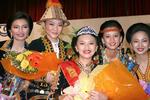
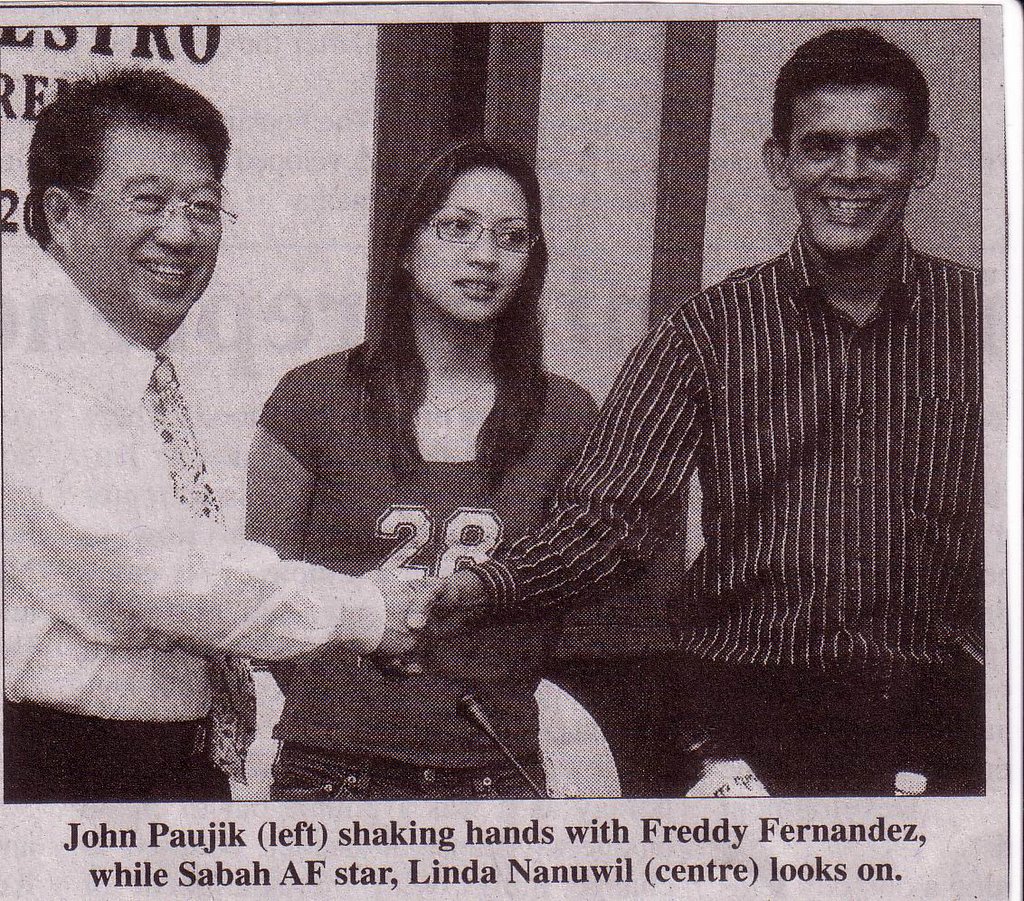
Recently (4/2/06), it appeared in the daily Express that the Kadazandusun Cultural Association (KDCA) and Maestro have sealed an understanding of cooperation to promote and market Sabah's Akademi Fantasia artises and singers. The understanding will also see both organizations undertake joint activities to develop talents from sabah to careers at the national level. representing Maestro Talents and Events management sdn Bhd was its Chief Operating Officer (COO), Freddy Fernandez, while KDCA was represented by Mr. John Paujik, a Central Committee Member. Under the undertanding, KDCA would be promoting the AF artistes through a series of concerts in sabah and possibly from the AF4, which would be starting its next season soon. The Kadazandusun AF artistes who were invited to become life members of KDCA were also appointed as KDCA ambassadors for the performing arts and music.
It is KDCA's hope that more talented young Kadazandusuns would become singers and musicians rising to national and international stature.
Recently, KDCA organized its first concert feautring Linda Nanuwil and other Kadazandusun singers and it would also be assisting to launch Felix Agus' first album, expected to be released in the next few months.
A percentage of proceeds from the concerts to be held in various places like Tamparuli, Kota Belud and keningau would be channeled to the Koisaan Educational Trust Fund, which is to help qualified Kadazandusun students puruse higher studies.
This is a development in the right direction. The Kadazandusun community is produd to have produced a number of talented Kadazandusun singers through the AF's avenue in the name of Linda Nanuwil, Felix Agus and Marsha Milan Londoh. The collaboration is indeed beneficial to both parties, and both would be able to expect win-win deal. To KDCA, it will be able to promote further the new-found talents and use their influences to bring message to the Kadazandusun community that they too could go further and success in their respective fields if they put their hearts and souls on their endeavours. For maestro, their concerts would be assured of spectators, and bring the AF's corporate image and business right to the heart of the Kadazandusuns.
More can be done in this collaboration, particularly during this Kaamatan. To show the goodwill and sincereity on the part of maestro, I suggest that Maestro take part in the forthcoming Kaamatan Celebration 2006. It can send and sponsor Linda, Felix and Marsha to perform in the Kaamatan as a good gesture and a way of thanking the Kadazandusun community for supporting their idols during the academy days. Another thing is, may be maestro could consider using Hongkod Koisaan for its forthcoming AF4 selection.
Indeed Linda, Felix and Marsha are the examples of the Kadazandusun youths. They are the idols and role models. It is indeed our hope that through Maestro, they could learn further the skills to survive in the local music and songs industry. It is also the hope of Kadazandusun community that Maestro does not exploit, rather to nurture, guide and protect them from any harms that normally associated with entertainment artistes.
And a simple message to our Linda, Felix and Marsha, "intang-intangan dikoyu mimpanau om kada lihuai koi hiti kampung".

PORTUGESE SETTLEMENT


KADAZANDUSUNS VISIT TO PORTUGESE SETTLEMENT IN MELAKA
By
Allan Dumbong


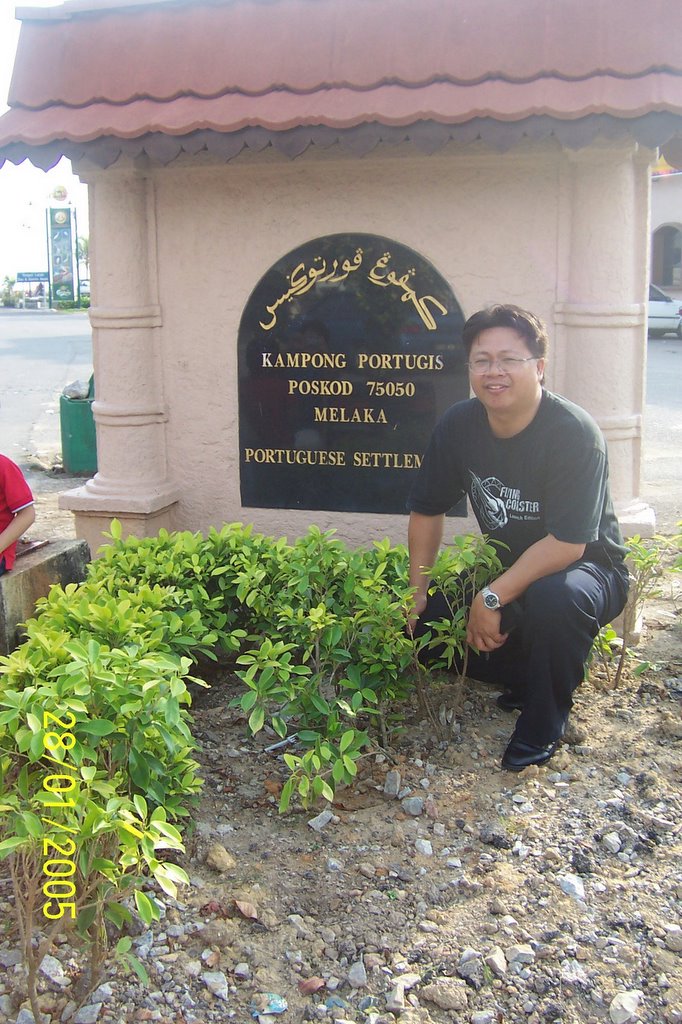
Recently I and other family members visited Melaka. Besides visiting the famous "A Farmosa", St Paul Hill, Stadhuys "red" Building, and of course the other new additions like the Istana Kesultanan Melaka, Museum, Independence Proclamation, we also took the opportunity to visit the Portugese settlement.

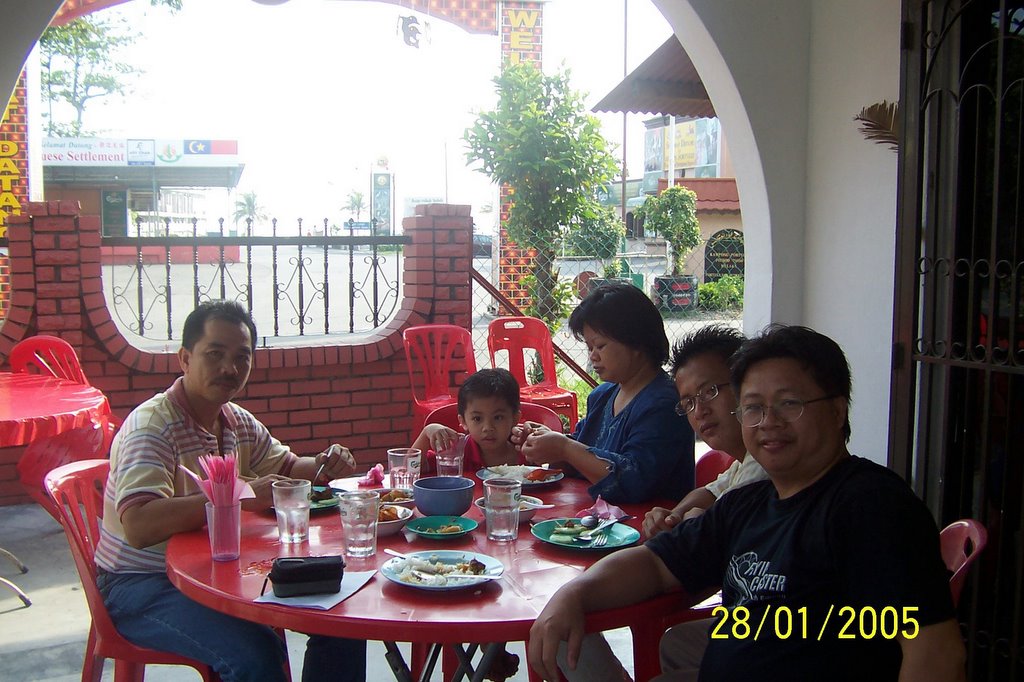
There we went through the Portugese housing area, passed through the Esplanade, and stop to look for makan, psss.. looking for "Portugese specialty". This brought us to a kedai makan located at the house coumpound of one Kessler family. There we eat mutton curry and few others. I also tried to start a conversation to know little bit about the Portugese settlement but the hosts were not in the mood to sit down and talk to us. Anyway, the 1/2 hour visit was not wasted, for I got the following information:

(i) The total population of Portugese Settlement was approximately 300 people, mostly Catholics and settled there since the Albuqaqie days in 1511 onwards.
(ii) The Portugese speak English, malay, and their own language. Ironically, an old man said that their dialect is not similar with the language spoken in Portugal but more like in Spain and Brazil. I failed to understand why.
(iii) My old friend, Gerard Fernandez, who is a resident in the Settlement is apparently sick and in serious condition. Gerard was the one who first brought me and other friends back in 1983 to the Settlement. There we put up for the nihgt and enjoyed Stevie Wonder's song " I just Call To Say I Love You", played by a group of Portugese (or rather the Fernandez) band boys. That time, Gerard's mother cooked for us "petai masak ikan bilis". That was my first time eating petai, which taught me to eventually cook petai that way. BTW, I am sorry that I was unable to visit Gerard who stays few blocks away as the day was getting late and we need to be back in Nilai, Seremban by 7pm.

Whilst the Portugese host were quite suspicious to us, though we introduced that we are visitors from Sabah and just want to see the Portugese settlement, we enjoyed our trip very much. We had no hidden agenda, more to try to learn about the Portugese way of life.